

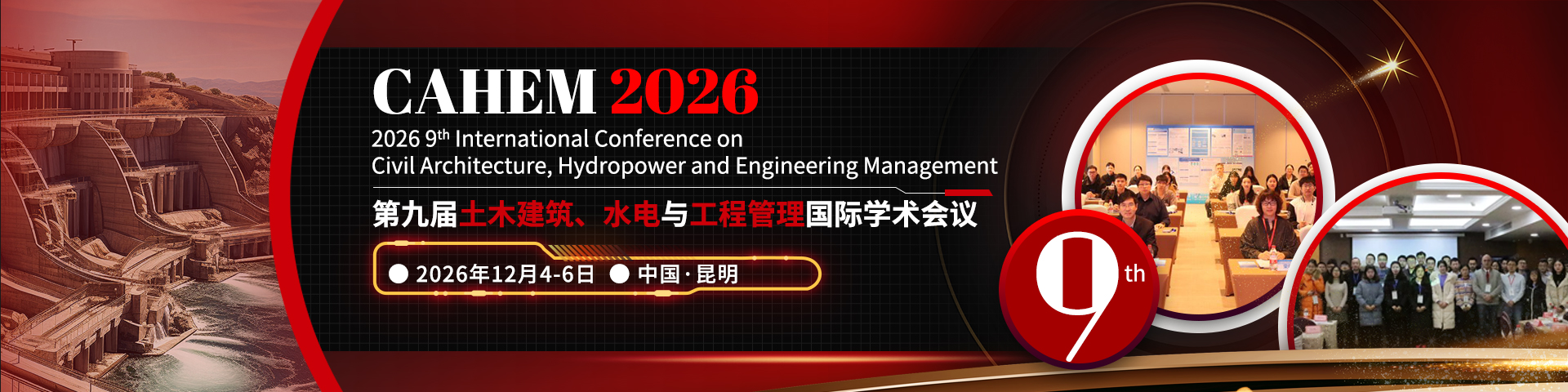
Welcome to CAHEM 2026 | Kunming, China | December 4-6, 2026
2026 9th International Conference on Civil Architecture, Hydropower and Engineering Management
Countdown to the Conference:
About CAHEM 2026
Driven by global urbanization and the continuous upgrading of infrastructure, civil engineering, architecture, hydropower, and engineering management have become crucial cornerstones supporting sustainable development. Green concepts and intelligent construction are propelling the civil engineering industry towards industrialization and smart transformation; hydropower, as a clean energy source, plays a key role in comprehensive water resource utilization and energy security; and engineering management provides scientific guarantees for major construction projects through life-cycle coordination and digital empowerment.
2026 9th International Conference on Civil Architecture, Hydropower and Engineering Management (CAHEM 2026) will be held from December 4-6, 2026, in Kunming, China. The conference will primarily focus on research areas such as "Civil Engineering," "Hydropower," and "Architecture." It aims to provide an international platform for collaboration and exchange, where experts, scholars, and enterprises in the fields of civil engineering, architecture, hydropower, and engineering management can share research outcomes, discuss existing problems and challenges, and explore cutting-edge technologies. The goal is to collectively drive the development of these fields, address new technological challenges, and serve societal needs. We warmly welcome scholars from around the world to contribute their papers and participate!
Important Dates
Submission Deadline
September 26, 2026
Notification Deadline
October 26, 2026
Registration Deadline
November 26, 2026
Conference Dates
December 4-6, 2026
Supported By

 Department of Civil Engineering
☛ Call For Papers
☛ Submission
☛ Publication
Call For Papers
The topics of interest for submission include, but are not limited to:
◕ Water Conservancy and Hydropower Engineering
◔ Hydraulics
◔ Hydrology and Water Resources
◔ Flood and Drought Management
◔ Irrigation and Water Conservancy
◔ Hydropower Planning
◔ Environmental Hydraulics
◔ Hydraulic Concrete Structures
◔ Hydropower Equipment
◔ Hydraulic Engineering Construction
◔ Hydropower Development
◔ Water Resources Planning and Using
◔ Water and Hydropower Calculation
◔ Port and Waterway
◔ Farmland Irrigation
◕ Civil Engineering
◔ Computational Mechanics
◔ Construction Technology
◔ Structural Engineering
◔ Monitoring and Control of Structures
◔ Structural Rehabilitation and Strengthening
◔ Reliability and Durability of Structures
◔ Geotechnical Engineering
◔ Geological Engineering
◔ Tunnel, Bridge and Subway
◔ Seismic Engineering
◔ Coastal Engineering
◔ Water Supply and Drainage Engineering
◔ Heating, Gas Supply, Ventilation and Air Conditioning Works
◔ Disaster Prevention and Mitigation
◔ Cartography and Geographic Information System
◕ Architecture and Building materials
◔ Building Science and Technology
◔ Building Equipment Engineering
◔ Building Energy Saving Technology
◔ Ecological Architecture
◔ The Traditional Building Materials
◔ New Building Materials
◔ Green Building Materials
◕ Engineering Management
◔ Urban Resource and Environmental Management
◔ Built Environment Management
◔ Urban Public Service Supply and Management
◔ Urban Traffic Management
◔ Environmental Management Systems
◔ Production Process Management
◔ Supply Chain Management
◔ Production Logistics System
◔ Logistics and Supply Chain Management
◔ Disaster Modeling and Simulation
◔ Accident Analysis and Prevention
◔ Public Safety Management
◔ City Management Enforcement
Submission
1. The submitted papers must not be under consideration elsewhere.
2. Please send the full paper(word+pdf) to Submission System.
3. Please submit the full paper, if presentation and publication are both needed.
4. Please submit the abstract only, if you just want to make presentations.
5. Templates Download.
6. Should you have any questions, or you need any materials in English, please contact us.
Publication
After 2-3 experts of the organizing committee strictly audited the contribution of the conference, all the final papers will be officially published in the Conference Proceedings. The published papers will then be submitted to CNKI, Google Scholar for indexing.
Note: All submitted articles should report original research results, experimental or theoretical, not previously published or under consideration for publication elsewhere. Articles submitted to the conference should meet these criteria. We firmly believe that ethical conduct is the most essential virtue of any academics. Hence, any act of plagiarism or other misconduct is totally unacceptable and cannot be tolerated.